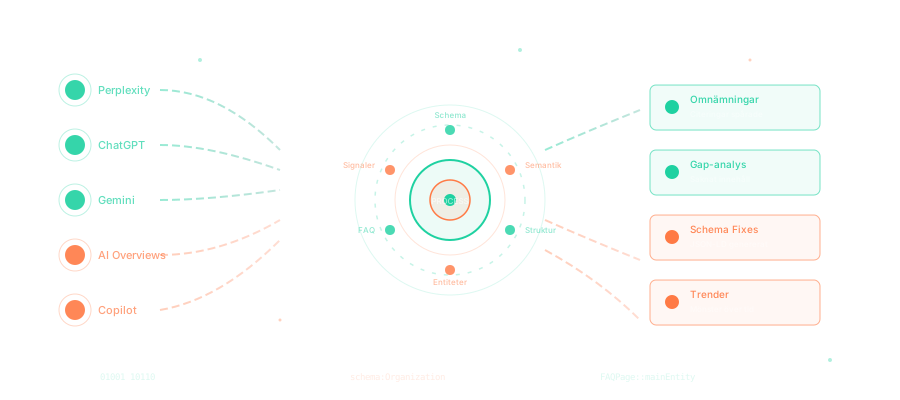
What is AEOmotor?
AEOmotor is a SaaS platform that monitors and analyzes how AI search engines like ChatGPT, Perplexity and Google Gemini cite your content. The platform uses deterministic analysis without AI guesswork for reproducible results. You see which questions generate mentions, which competitors are cited and how your visibility changes over time. All data can be exported for independent verification.
What are the technical requirements?
You need a website where you can publish JSON-LD schema markup. The platform works with WordPress, Webflow, Squarespace, static sites and headless CMS like Contentful or Sanity. The only requirement is that you can add structured data to your HTML code. No server installation is required and no plugins are needed for basic functionality.
How long is the implementation time?
You get access to the platform immediately after registration. Initial configuration of keywords and monitored AI engines normally takes 15-30 minutes. The first monitoring runs according to your chosen frequency, either daily or weekly. Schema generation and implementation on your website can be done the same day if you have access to edit HTML.
What plans are available?
SME costs SEK 1,990/month and includes 100 keywords, 3 AI engines and weekly monitoring. Enterprise costs SEK 4,990/month with 300 keywords, 5 AI engines and daily monitoring. Agency is quote-based for SEO agencies with unlimited keywords. Strategic Partnership from SEK 49,900/month includes ongoing partnership with external AEO strategist. All plans run without lock-in period.
How secure is the platform?
AEOmotor only analyzes publicly available content and has no access to your databases or admin panels. All data is stored securely within the EU according to GDPR. You have full control over your keywords and reports. No external data leaves the platform without your involvement. Monitoring occurs via standardized API calls to the AI engines.
Is there a lock-in period?
No, all plans run monthly without lock-in period or commitment. You can cancel anytime and it takes effect from the next billing period. There are no hidden fees or notice periods. The schema code you implemented on your website continues to work even after subscription ends because it resides on your own server.
How does AEO differ from SEO when AI assistants choose sources?
SEO optimizes for positions in traditional search results where rankings, backlinks and domain authority determine visibility. AEO optimizes for AI-generated answers where there are no positions – just the choice to cite or not cite. AI systems like ChatGPT and Perplexity value structured data, clear answers and semantic correctness rather than link profiles.
Why do AI answers use no scores or rankings?
AI-generated answers work fundamentally differently than traditional search. There are no positions 1-10, just one answer compiled from multiple sources. A calculated AEO score would be arbitrary and have no connection to how AI systems actually work. Instead, observable signals are more relevant: whether you are mentioned or not, which competitors are cited, and how this changes over time.
How can I measure the effect of structured data in AI answers?
The effect is measured by tracking mentions and citations in AI systems over time. When you implement Schema.org markup or improve content structure, you can observe whether citation frequency changes at the next monitoring. Long-term trends show patterns that individual data points cannot capture. History over 60-365 days provides a basis for assessing actual impact.
Which AI assistants affect visibility for businesses in 2026?
The five largest AI systems that generate answers based on web content are Perplexity, Google Gemini, OpenAI ChatGPT with web search, Google AI Overviews (integrated into Google Search) and Microsoft Copilot via Bing. These systems have different model behaviors and may cite different sources for the same question. Monitoring multiple AI engines gives a more complete picture of your visibility.
How does deterministic analysis of AI citations work?
Deterministic analysis means that schema validation, structure checks and fix generation are done with fixed rules instead of AI guesswork. This ensures reproducible and verifiable results. Monitoring collects actual AI-generated answers from various AI engines and analyzes them systematically. Separation between raw data, analysis and presentation makes it possible to export and verify results independently.