
AEOmotor: platform for AI visibility
AEOmotor analyzes how your company appears, is described and is cited in AI answers from tools like ChatGPT, Gemini and Perplexity. The platform gives B2B teams and agencies clear reports, competitor comparisons and practical recommendations for AEO and GEO.
No scores. Just observable signals you can act on.
2025 marked a clear shift where AI-based search and AI-generated answers went from experiment to strategic focus for the largest players.
- Perplexity positioned itself beyond traditional search and launched Comet, an AI-enhanced browser experience.
- Microsoft integrated Copilot deeply into Edge and developed Copilot Search as a central part of its platform.
- OpenAI introduced ChatGPT Atlas as a step towards more agentic web interaction.
- Google rolled out AI Overviews and experiments with Disco for AI-driven workflows.
This changes how visibility works. This is the environment AEOmotor is built for.
What is AEOmotor?
AEOmotor is an AEO infrastructure and SaaS platform for organizations that need to understand how AI systems select, summarize and cite content.
The platform is developed for environments where answers are generated, not ranked. AI systems use no scores or positions. Therefore, neither does AEOmotor.
What the platform shows
Mentions
Whether and how your name appears in AI answers.
Citations
When you are cited as a source, and in which questions.
Sources AI trusts
Which sources AI leans on in your industry.
Competitor presence
Who gets mentioned instead of you, in the same answer.
History over time
How your presence changes as AI answers update.
Ongoing monitoring
Monitoring that catches changes automatically.
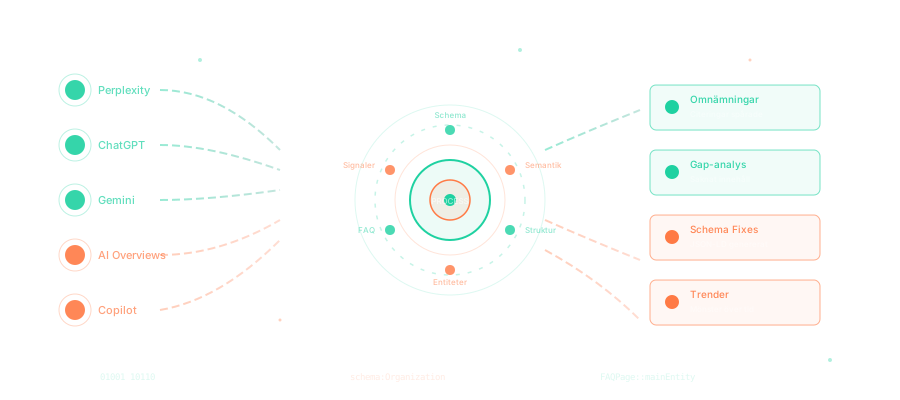
How it works
Analysis and current state
You enter your domain, brand, industry and any competitors. The system crawls your core pages and analyzes structural signals that AI systems use to understand and cite content.
This includes structured data according to Schema.org, content structure and hierarchy, entity structure and technical prerequisites.
The analysis is deterministic and rule-based. No AI guesswork.
Gap detection
The system identifies search queries where you should be visible but are not. Each gap is classified as:
- Missing content
- Weak structure
- Authority gap
- Model behavior (differences between AI engines)
Gaps that can be addressed are prioritized based on actual impact.
Schema Fixes
For identified issues, the system generates ready-to-use Schema.org fixes that can be implemented directly on the website.
- FAQPage, Organization, WebSite, Breadcrumb
- llms.txt and ai.txt for AI crawlers
Everything is deterministic and based on your actual data. No AI-generated suggestions.
Dashboard and AEO work
Everything is collected in a dashboard where you can see the status of all factors, add keywords for monitoring, implement actions and follow how your mentions develop over time.
The platform is built for continuous work, not one-time analysis.
AI agent
The AI agent is built into the platform and helps you interpret measurements and analyses and prioritize the right actions. It explains why something is missing, helps you interpret content gaps and answers follow-up questions, such as where to start.
The AI agent bases its guidance on your actual data and the analysis the system has already performed.
Tracking over time
After implementing changes, you follow how AI mentions, citations and sources change over time. This makes it possible to see long-term patterns, not just individual changes.
What sets AEOmotor apart
Built for AI systems, not search engines
Classic SEO tools measure rankings, backlinks and domain authority. AEOmotor measures how AI systems select, summarize and cite information.
No scores or indices
AI-generated answers have no positions. Therefore, we show mentions, citation frequency and competitor presence, observable signals that actually affect visibility.
Deterministic analysis
Where possible, we use rule-based analysis instead of AI guesswork. Schema validation, structure checks and fix generation are 100% deterministic.
Separation between data and presentation
Raw data is separated from analysis and presentation. You can export, integrate and verify without being locked into our interpretation.
GDPR as an architecture principle
Data separation and privacy protection are built in from the start, not added as an afterthought.
Solutions for your needs
The platform is built for agencies working with their clients' AI visibility and for companies working on their own. Contact us for a current plan.
For agencies Solutions for companiesOperations and data location
AEOmotor is built and operated in Microsoft Azure with data located in Sweden through Azure Sweden Central. All processing takes place within the EU and is adapted for organizations with high requirements for data protection and regulatory compliance.
GDPR and data separation are architecture principles from the start.
Frequently asked questions
What is AEOmotor?
AEOmotor is a SaaS platform that monitors and analyzes how AI search engines like ChatGPT, Perplexity and Google Gemini cite your content. The platform uses deterministic analysis without AI guesswork for reproducible results. You see which questions generate mentions, which competitors are cited and how your visibility changes over time. All data can be exported for independent verification.
What are the technical requirements?
You need a website where you can publish JSON-LD schema markup. The platform works with WordPress, Webflow, Squarespace, static sites and headless CMS like Contentful or Sanity. The only requirement is that you can add structured data to your HTML code. No server installation is required and no plugins are needed for basic functionality.
How long is the implementation time?
You get access to the platform immediately after registration. Initial configuration of keywords and monitored AI engines normally takes 15-30 minutes. The first monitoring runs according to your chosen frequency, either daily or weekly. Schema generation and implementation on your website can be done the same day if you have access to edit HTML.
What plans are available?
AEOmotor is available for agencies working with their clients' AI visibility and for companies working on their own, either in the platform or through a strategic partnership. Pricing and packaging are under review. Contact us for a current plan, or read more under For agencies and Solutions.
How secure is the platform?
AEOmotor only analyzes publicly available content and has no access to your databases or admin panels. All data is stored securely within the EU according to GDPR. You have full control over your keywords and reports. No external data leaves the platform without your involvement. Monitoring occurs via standardized API calls to the AI engines.
Is there a lock-in period?
No, all plans run monthly without lock-in period or commitment. You can cancel anytime and it takes effect from the next billing period. There are no hidden fees or notice periods. The schema code you implemented on your website continues to work even after subscription ends because it resides on your own server.
How does AEO differ from SEO when AI assistants choose sources?
SEO is about appearing in traditional search results. AEO is about how AI systems understand, select and cite content when they generate answers. There are no positions, just the choice to cite or not cite. AI systems like ChatGPT and Perplexity value structured data, clear answers and semantic correctness rather than link profiles.
Why do AI answers use no scores or positions?
AI-generated answers work fundamentally differently than traditional search. There are no positions 1-10, just one answer compiled from multiple sources. A calculated AEO score would be arbitrary and have no connection to how AI systems actually work. Instead, observable signals are more relevant: whether you are mentioned or not, which competitors are cited, and how this changes over time.
How can I measure the effect of structured data in AI answers?
The effect is measured by tracking mentions and citations in AI systems over time. When you implement Schema.org markup or improve content structure, you can observe whether citation frequency changes at the next monitoring. Long-term trends show patterns that individual data points cannot capture. History over 60-365 days provides a basis for assessing actual impact.
Which AI assistants affect visibility for businesses in 2026?
The five largest AI systems that generate answers based on web content are Perplexity, Google Gemini, OpenAI ChatGPT with web search, Google AI Overviews (integrated into Google Search) and Microsoft Copilot via Bing. These systems have different model behaviors and may cite different sources for the same question. Monitoring multiple AI engines gives a more complete picture of your visibility.
How does deterministic analysis of AI citations work?
Deterministic analysis means that schema validation, structure checks and fix generation are done with fixed rules instead of AI guesswork. This ensures reproducible and verifiable results. Monitoring collects actual AI-generated answers from various AI engines and analyzes them systematically. Separation between raw data, analysis and presentation makes it possible to export and verify results independently.
Ready to understand your AI visibility?
No hype. No scores. Just observable signals you can act on.